
Swapfiets: Dutch icon that has never made a profit
The blue belt that conquered the Netherlands is looking for black figures
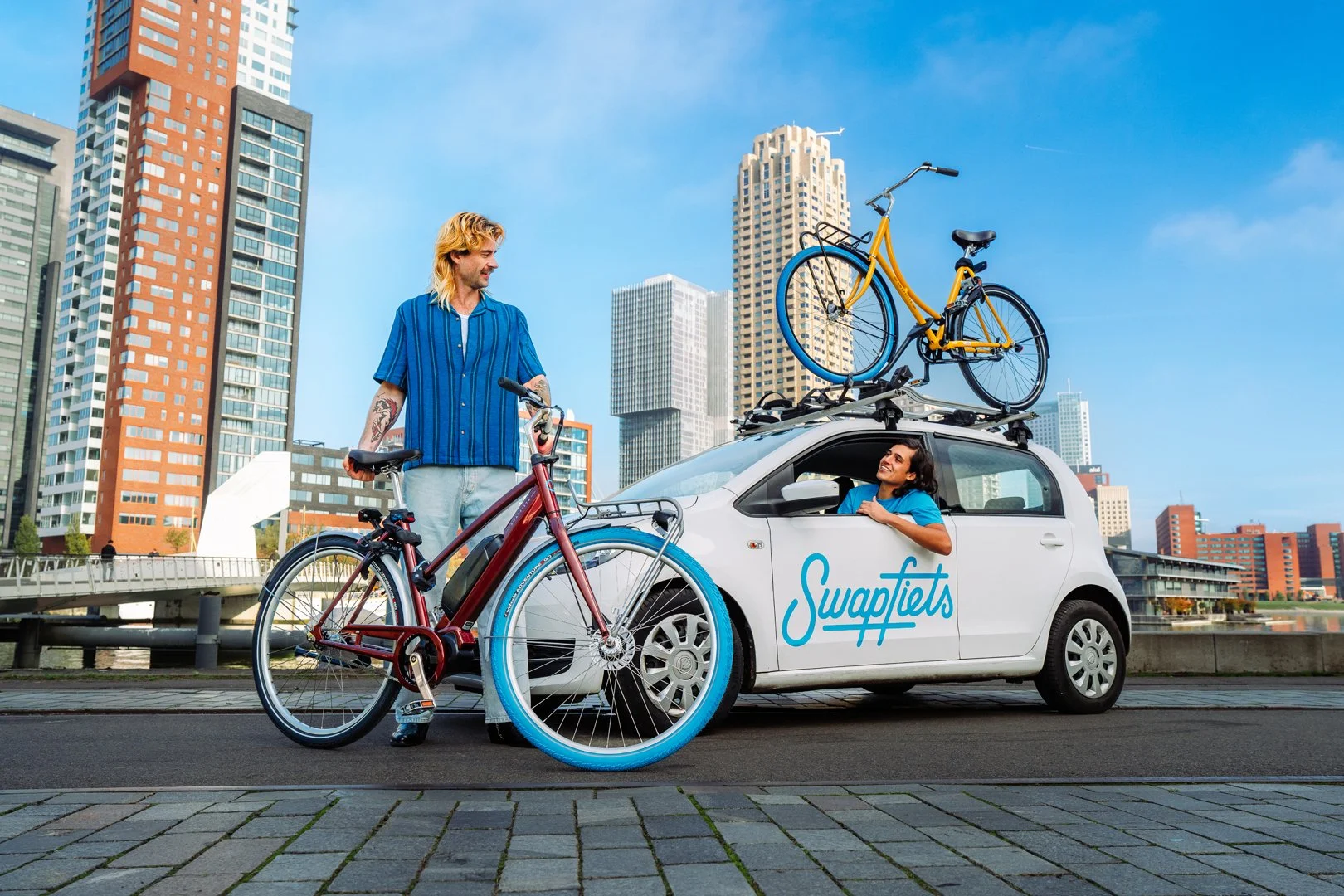
In 2014, somewhere in Delft, a student was cycling around on a bicycle with a striking blue front tire. Nobody knew then that this colour – inspired by the Delft blue of the city where four friends hatched an idea – would become one of the most recognisable brand symbols in the Dutch street scene.
Founders Swapfiets – photo Quote
Eleven years later, you stumble over the Swapfietsen. In Amsterdam alone, there are 64,000 driving around. In Utrecht, Groningen, Rotterdam, Nijmegen – wherever students live, you see them in the streets. That blue band has become a kind of status symbol, a sign that you understand how the world works: you no longer own a bicycle, you subscribe to it.
The concept is so simple that you wonder why no one came up with it before. For a fixed amount per month – from €16.58 for a classic city bike, to €64.90 for a powerful e-bike – you get a working bike under your butt.
Flat tire? They come along. Chain broken? Settled. Stolen? A new one within 48 hours (a fine though). No hassle with bicycle repairs, no unexpected repair costs, no stress about theft in a country where more than 86,000 bicycles are reported stolen every year – and the actual number is much higher.
Swapfiets grew rapidly. From a handful of bicycles among college friends to 100,000 subscribers in 2018. From Delft to Germany, Belgium, Denmark, France, the United Kingdom. At its peak, they were active in 60 cities in nine countries, with 1500 employees and hundreds of thousands of bicycles on the streets. It became one of the best-known Dutch scale-ups, a textbook example of the "subscription economy".
But (yes, there it is again) behind the blue bands lies a story that is less shiny than the street scene suggests.
Swapfiets has never made a profit
Profit? Only loss. And not a little loss. Structurally, year after year, tens of millions in the red. In 2020: €15 million loss. In 2021: €29 million. In 2022: €31 million. In 2023: €23 million. In 2024: €14 million. Add it up and you come to more than €140 million cumulative loss. And that does not include the more than €150 million that parent company Pon Holdings has pumped into the company over the years through capital injections and loans.
The customer base – the indicator for a subscription company – has been virtually at a standstill for three years. End of 2022: 269,000 subscribers. End of 2023: 266,000. End of 2024: 267,000. The website now claims "280,000+ members", but even if that's true, it's a growth of barely 4% in three years. For a company that once talked about one million users in 2025, that's a wet pair of pants after a bike ride. That ambition has now been quietly abandoned.
Today, Swapfiets is a fundamentally different company from the startup that started in 2014. All four original founders have left. It is now run by CEO Marc de Vries, who previously sold Hyves and led Twitter Benelux. If there is anyone who should be able to do this, it should be Marc. Moreover, a very good storyteller, someone with a strong network and a nice guy, I know from my own experience.